

Cabinet Information – audio guide available
As with every piece of equipment used in the game of cricket, the ball has had an interesting evolution which continues to this day.
Cricket balls are often collected and prized by players and supporters alike; especially if the said ball has taken a significant number of wickets in a match.
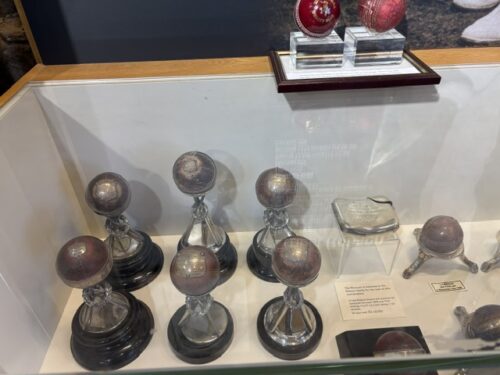
Some of these cricket balls are mounted on a stand in celebration, which can be seen on display. Noteworthy are the balls used by Beaumont Cranfield playing for Somerset in the match against Lancashire in June 1902 at Manchester, where he achieved figures of 6 for 61 and 8 for 65
Also amongst the collection are a number of balls showing the exploits of Ernest Robson which almost span his time as a professional at the Club – here are examples from 1896-1922.
Robson played 424 matches for Somerset scoring 12 thousand 427 runs, taking 1,122 wickets and 256 catches.
Along with the balls is a silver snuff box and a silver hip flask; all are kindly loaned to the Museum by the Robson family.
Further around the Museum, in the large cabinet of equipment, the changes in the style of the ball can be seen clearly. The size of the balls has barely altered, but the use of materials and colour are significantly different.
When day/night cricket matches came into being, it was found that the standard red ball was too dark to be seen well enough and the white ball was not tough enough to last for a long innings. Thus the pink ball was developed to help satisfy the specific criteria.
The pink ball was first used for an international match in 2009 at Wormsley in a game between the England Women’s Team and Australia.
Before modern awards became common, players were frequently presented with engraved cricket balls to commemorate major achievements such as centuries, five-wicket hauls, or Test match performances.
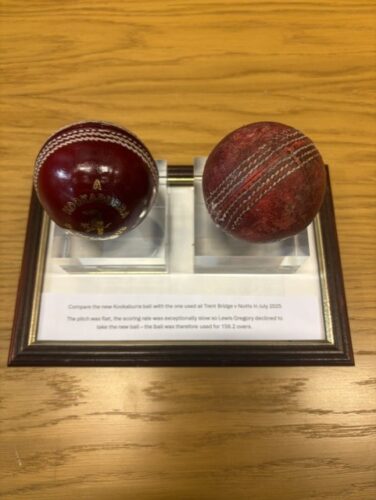
One Somerset ball lasted 159 overs – A Kookaburra ball used by Somerset against Nottinghamshire in 2025 remained in use for an astonishing 159.2 overs because Lewis Gregory, the captain, chose not to take the new ball.
Video – The differences between red and pink cricket balls.
Video – How cricket balls are made. A throwback to how cricket balls were made some 70 years age. Many parts of the production remain hand made to this day although scale of production often relies on some parts of the process to be completed by larger machinery. Follow link to watch on YouTube.
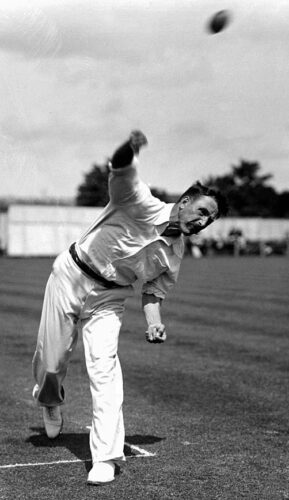
Ernest “Ernie” Robson was one of the most dedicated and influential cricketers ever to represent Somerset County Cricket Club. Born in Leeds in 1870, he joined Somerset in 1895 and remained a key figure for almost three decades, playing his final first-class match in 1923 at the remarkable age of 53. During that time he appeared in 432 first-class matches for the county, taking 1,147 wickets and scoring more than 12,000 runs, achievements that placed him among Somerset’s greatest servants.
A right-arm fast-medium bowler and useful lower-order batsman, Robson was renowned for his stamina, reliability and competitive spirit. At a time when county professionals often carried a heavy workload, he was frequently called upon to bowl long spells and was one of the most dependable members of the Somerset side. By the time he retired, he had taken more wickets for Somerset than any other player in the club’s history, a record that stood until it was later surpassed by Jack White.
Robson was also an accomplished sportsman away from cricket. During the 1896–97 season he played professional football as a right-back for Bristol South End, the club that would later become Bristol City Football Club.
Sadly, Robson died in Bristol in May 1924 at the age of 54 following an operation. Despite his passing more than a century ago, his contribution to Somerset cricket continues to be remembered.
The cricket balls displayed in this museum are known as the Ernest Robson Trophy Balls. They form part of a collection of trophies and memorabilia associated with his long Somerset career and were loaned to the Somerset Cricket Museum by members of the Robson family. These historic balls provide a tangible link to one of the county’s earliest professional stars and help tell the story of a player whose commitment and longevity helped shape Somerset cricket during its formative years.
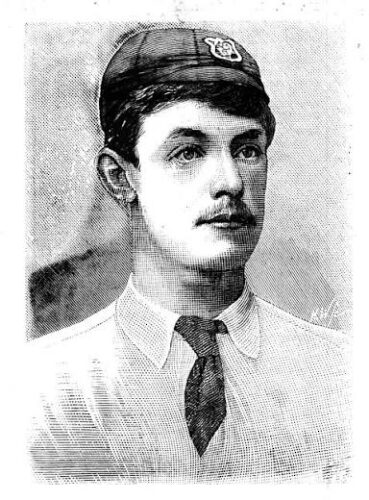
Teddy Tyler (Somerset 1891-1907) was a slow left arm bowler, whose record speaks for itself. He was a key member of the Somerset side that finally achieved First Class status. In 1894, he took 124 wickets, which included his 10 for 49 against Surrey, at the Oval.
In 1896, England rewarded him with his one and only Test against South Africa. Concerns about his action limited his Test appearances (the rules were tightened in 1900).
Somerset highlights:
- First Somerset player to take a County Championship hat trick, against Yorkshire in 1895. The ball presented in an eagle’s claw is the hat trick ball (kindly donated by Brian Lee).
- Only Somerset player to take all 10 in an innings in the County Championship (10 for 49 against Surrey in 1894).
There is also a silver cigarette box in the silver cabinet, that was awarded to him in recognition of his marathon match spell against Gloucestershire – 61 overs – 23 maidens 14 wickets for 122 runs.
How is it different from the red ball ?
Although the core construction is largely the same, the pink ball receives additional layers of pigment and lacquer to help it retain its bright colour throughout a five-day match. It also uses a black seam to improve visibility.
These changes affect how the ball behaves:
- It often swings more dramatically when new.
- It can move more under floodlights, particularly during the evening session.
- It tends to skid through more quickly off the pitch.
- It can lose its effectiveness suddenly after 20–30 overs.
- It generally offers less reverse swing and can provide less assistance to spin bowlers as it ages.
Was pink the first coloured trialled ?
The pink ball was not the first colour trialled. Orange and bright yellow versions were tested before pink became the preferred choice.
The Pink Cricket Ball – Innovation or Controversy ?
The pink cricket ball is one of the most debated innovations in modern cricket. Introduced to make day-night Test matches possible, it has transformed how the longest format of the game is played, watched and discussed.
When did the first pink ball appear ?
The idea emerged in the late 2000s as cricket administrators looked for ways to attract larger crowds to Test cricket. Traditional Test matches were played during working hours, making it difficult for many fans to attend. Various coloured balls were trialled, including yellow and orange, before pink was chosen as the best compromise for visibility.
The first official day-night Test match using a pink ball was played between Australia and New Zealand at Adelaide Oval in November 2015. The International Cricket Council (ICC) approved day-night Tests in the same year.
Why do some players like it ?
Fast bowlers are often the biggest supporters of the pink ball. The extra swing and seam movement can make batting much more difficult, especially during twilight when natural and artificial light combine.
Many broadcasters and cricket administrators also favour pink-ball Tests because they allow spectators to attend after work, creating larger crowds and television audiences. The first day-night Tests attracted significant public interest and helped introduce Test cricket to new audiences
Why is it controversial ?
The biggest criticism is that the pink ball can behave very differently from the traditional red ball.
Many batters complain that the ball becomes difficult to see during the twilight period. Research involving professional cricketers found that visibility is often worst at dusk, with some players reporting a blurring effect or visual “trail” under floodlights.
Others argue that the ball gives too much advantage to fast bowlers and creates conditions that are less representative of traditional Test cricket. Some teams have become so uncomfortable with the format that they have publicly questioned future day-night Tests. Following the 2025–26 Ashes, England indicated they would oppose future pink-ball Ashes Tests in Australia.
Spin bowlers are often less enthusiastic because the pink ball can resist the natural wear that helps create turn and reverse swing later in a match.
Who tends to support it and who doesn’t ?
Generally supportive:
- Fast bowlers
- Broadcasters
- Stadium operators
- Fans who enjoy evening cricket
- Administrators looking to grow Test cricket
Often more critical:
- Batters who struggle with visibility at dusk
- Some spin bowlers
- Traditionalists who believe Test cricket should be played with a red ball only
- Teams less experienced in day-night conditions
Conclusion
The pink cricket ball represents one of cricket’s greatest modern experiments. Supporters see it as a clever innovation that keeps Test cricket relevant in the 21st century. Critics argue it changes the character of the game too much. Whether viewed as a brilliant solution or an unnecessary gimmick, few pieces of cricket equipment have sparked as much debate as the pink ball.
Throughout it’s life the museum has been generously supported by a membership scheme. There are currently about 85 members who pay £5 a year although many add a donation. The museum would not have survived over the years without their continuing support and donations from Visitors.
Audio File – Cabinet Information
Cabinet Information Audio
Additional Videos
Our Sponsors
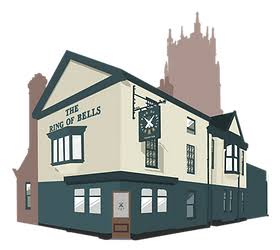
The Ring of Bells is a pub in the heart of Taunton situated less than a minute from the Somerset County Cricket Ground on St James Street
Whether you are having a working lunch, a drink after work or an evening out there is a part of the pub that will suit you. They have brought an ‘Out of Town’ Pub into the centre of Taunton.
Our Social Media Links
You must be logged in to post a comment.