

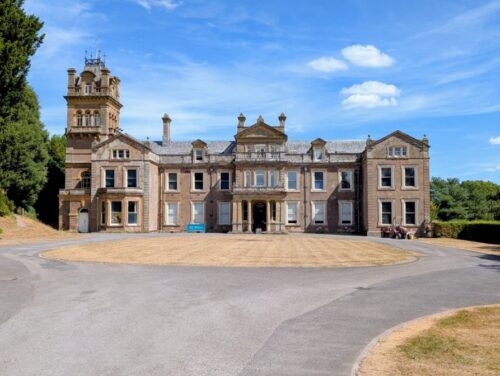
The Hon E. W. B. ‘Teddy’ Portman was the eldest of five surviving sons of the second Viscount Portman. He was heir to the extensive Portman Estates and moved into Hestercombe in December 1894 with his wife of two years, the Hon. Constance Mary Lawley (the House being ‘made over’ to him by his father). Conscious of his priorities Teddy soon became its cricketing patron.
That said, his enthusiasm for the game had waxed and waned; rowing and then polo had been his sporting interests in his youth. He was nevertheless a close friend of Lionel (L.C.H.) Palairet the Somerset and England batsman whom he joined on hunts organised by the Taunton Vale Foxhounds for whom he acted as Master 1897-1900.
Cricket had just got underway when Teddy arrived. The nascent Cheddon and District Cricket Club had used a pitch on the Hestercombe estate in its first two seasons 1893 and 1894, the pitch being sited on in parkland rented by a tenant farmer John Blackmore. It is shown here, circled, below the present-day entrance drive, top of image, which follows the tree-lined route down to the front of the house[1].
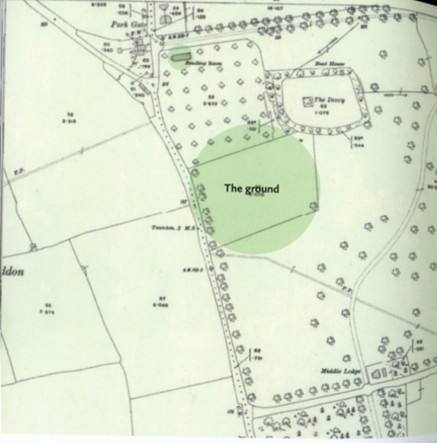
[1] Image courtesy of Neville Gabie
It seems to have been a well organised and funded club. The Somerset County Gazette noted its satisfaction at the almost £5 (£850 today) held at the beginning of the 1894 season alongside the fact that a Second XI was being mooted.
But things developed further. In 1895 the Cheddon club became Hestercombe CC largely due to the patronage of Teddy Portman himself. Firstly he became club president. Then he had the existing ground levelled and further developed during the 1894/95 winter. The Somerset County Gazette was in no doubt that it would become one of the best country cricket grounds in the county, ‘’… the position being quite unique and the view perfect’’.
The new Hestercombe club inherited an impressive fixture list including Bridgwater, Chard, Combe Florey and Castle Cary. The summer of 1895 – its first season – was judged to be a successful one with 9 games won, 2 drawn and 4 lost. One of those drawn matches was against St Decuman’s, a team from Watchet who hosted Hestercombe in July of that year. The West Somerset Free Press tells us that the match was bedevilled by thunderstorms prompting the home team’s captain to declare at 86 for eight. The Hestercombe men went for the runs, making the most of the bowlers’ discomfort with the slippery ball – but fell four short when time was called (no thought of ‘an extra over’ and quite rightly so; village cricket is a serious matter). Hestercombe’s Salter and England were noteworthy for their positive approach in the run chase.
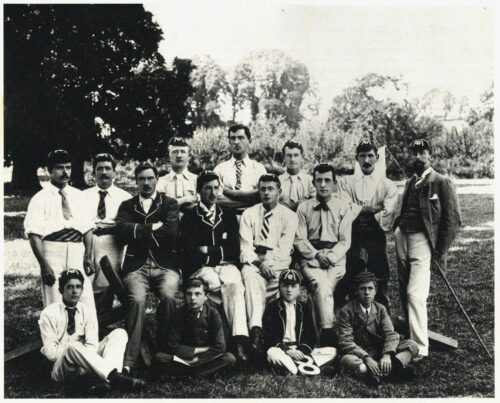
Salter appeared again in the 1896 season including in the match at Hestercombe’s ground against Bishop’s Lydeard in June scoring 33 in the home side’s total of 95. Teddy himself turned out in this match scoring seven in the middle order. Good on him as he would have been 40 at this point. Willam Duppa Miller his private secretary batted higher in the order and scored 14. He appears in the scorecard as ‘Mr Miller’ perhaps reflecting the fine gradations of society at that time. He is on the extreme right in this circa 1896 team photograph leaning on his cane
At the second annual general meeting of the HCC held in January of that year it was announced that a new pavilion was to be built before the coming season ‘if possible’. In fact, the Reading Room, as it came to be called, was slow to be built and, in reality, never seems to have served as a pavilion for the club.
Pavilion or no pavilion 1897’s fixture list was no less demanding than that of the previous year. North Curry was one of those teams already known to the Hestercombe men and it gave rise to an exciting encounter that June at Curry’s ground on a ‘hard and fiery wicket’. In what was a two innings match beginning at 1130 North Curry batted first but Hestercombe’s first innings reply was badly affected by the ‘midday feast’ according to the Somerset County Gazette. North Curry, sensing their chance, then moved ahead in their second innings before tea was taken. In that final session however Hestercombe steadied themselves and made the 46 runs required in 45 minutes in what must have been a fluctuating and exciting game. For the visitors George Pleass (one of four Pleasses who played for the team, sometimes in the same game) batted well. And Holman the captain and Salter bowled excellently.
Teddy died in April 1911. The club continued without his guiding hand, re-adopting its original Cheddon Fitzpane name in the process. Some fixtures continued to be played at the ground but, as the Estate’s own narrative poignantly recalls, ‘the great era of Portman sponsorship had ended’. Despite some use in the late 1940s and early 1950s the ground then fell into disrepair and was eventually abandoned.
You must be logged in to post a comment.