

Overlooked by most visitors to Barrington Court in Somerset is its cricket pitch. Today it is quiet and unused. But in the past, its champion, its enthusiast, was Colonel Arthur Lyle. Injured aged 35 at the Battle of Aubers Ridge in May 1915 he appears not to have returned to active service; maybe thoughts of cricket were a lifeline during unimaginably dark days.
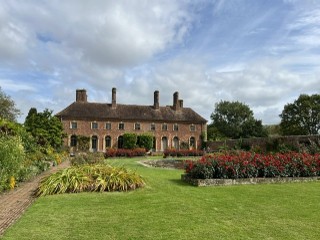
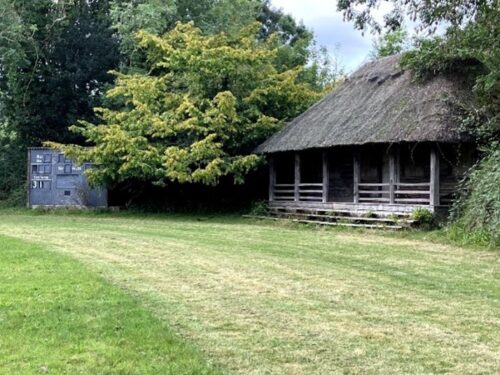
His signing of a 99-Year Barrington Court lease in 1920 would, said the National Trust, ‘bring back a dead thing to life again’ (the house was in some disrepair). Importantly for it included the construction two years later of a new pavilion with a Norfolk reed thatch. At some point the roof was ‘’extended over the Ladies’ W.C. at the back’’ no doubt to the benefit of all concerned although it wasn’t until 1924 that the pitch was levelled, an exercise we know from Estate Records involved taking it up and laying it again.
But was there already a pavilion? National Trust records talk of one having previously existed which was ‘damaged by fire in 1909/10 and rebuilt’[1]. That seems to be refuted by maps from the early 20th Century. Shown here on the left, is the Ordnance Survey of that time.
[1] National Trust HBSMR Number 111428
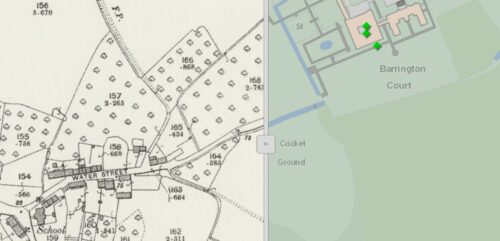
It’s clear that there isn’t a pavilion nor even a ground, simply a tree-less field (bottom right hand corner of older map, left hand panel); the modern equivalent overlay, right, confirms the position of the Cricket Ground. The pavilion today is adjacent to the ‘164.383’ symbol ringed in red[1].
The pavilion was an attractive addition. A report in the Langport and Somerton Hearld from July 1924, eulogised that, ‘The fixture [against Curry Rivel and presumably on this newly laid wicket] was fulfilled on Saturday last in brilliant sunshine. The Barrington ground was in beautiful condition but the most comfortable seat was undoubtedly in the oak, thatch-roofed pavilion of which the homesters are justly proud.’’
One such homester was Colonel Lyle himself. He put the ground at the disposal of the village and reports show him batting in the middle order for the Barrington Club, formed in the mid-1920s to coincide, one assumes, with the creation of the ground. Low scores all round seemed to have been the order of the day (at least to modern eyes) although it’s not clear from the reports how much of this was down to the quality of the wicket.
What is clear is a playing connection with Barrington Court itself, one newspaper reporting in the early 1930s that ‘‘…many members [of the Barrington village side] which played on the grounds at the Court, are estate employees.’’ This Barrington side became responsible for the maintenance of the pavilion and cricket pitch, an arrangement that became official only in 1991.
And as for an actual Court Team? As well as against matches against the village side, Barrington CC, Somerset Stragglers yearbooks from the 1920s and 30s record matches against ‘Barrington Court’. The 1933 edition records a close and exciting encounter against the latter played at the Barrington Court ground. Stragglers contained some seven county players including Bill Greswell and Guy Earle. Leading on the first innings by 96 they then struggled to contain the home side in their second innings, Barrington Court running up a total of 302. Stragglers went for the 207-run target, fighting for quick runs. But in a fairly matter of fact fashion the yearbook records that ‘the Stragglers could only get within twelve of the total, still having two wickets to fall’.
Whether Village or Court, these halcyon days were shaken by the death of the Colonel in 1931, The Courier of February 18th that year lamenting that ‘‘Cricketing circles in Somerset have lost a true friend in Colonel Lyle’’.
In 1934 the pavilion was moved a short distance eastward to allow for the introduction of a new farm track at the west end of the pitch. And more upheaval was to follow; during the second world war matches transferred to a location near to the Court (more pressing matters – food cultivation – taking priority on the main Ground)[2].
Despite returning to its ‘proper’ location following the war, cricket here has sadly ceased in recent years. But like the House itself it is a dead thing ripe for bringing back to life again.
[1] Image courtesy of Know Your Place.
[2] National Trust information on Barrington Court communicated to the author 6 Oct 2024
You must be logged in to post a comment.