

Kenneth Robert Murchison was not Bathford born and bred. He was a product of Empire first peering out through his cot’s mosquito net in Penang in 1829. His father had been successively Resident Councillor of Singapore and the third Governor of the Straits Settlements and had found time while there to conduct a geological survey of Penang on behalf of his brother Roderick. Maybe an interest in rocks and rivers rubbed off on son Kenneth Robert: The Royal Geographical Society lists K.R. (Kenneth) Murchison, resident at the ‘Manor-house, Bathford’ as having been elected as a member in 1859.
It was from here – the Manor-house – that K.R. hosted organised cricket and by 1863 he had become a distinguished vice-president of the prestigious Lansdown club some six miles away in Bath.
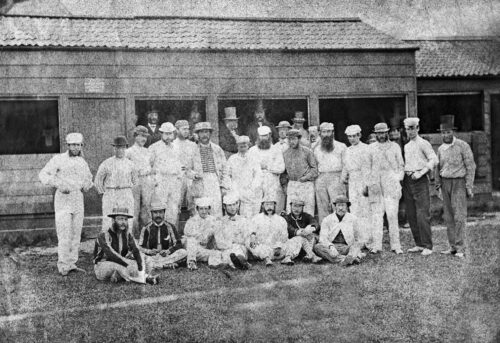
Twenty-Two of Lansdown who played the All-England XI in 1863. (Image courtesy of Lansdown Cricket Club)
The games at Bathford that we find reported were between members of that same Lansdown Club[1]. By the middle of the nineteenth century its reputation had grown such that it was hosting the likes of Oxford University and MCC. However seriously or not these intra-Lansdown games were played it is likely therefore that the players would have been of a reasonable standard. The Bathford scorecards describe the matches as having been contested between the Town (Lansdown) and Country (Bathford).
A report from The Bath Herald of 29 August 1863 recounts just such a game. It tells us that Murchison had invited Lansdown CC to play a friendly match at Bathford and ‘…the ground selected for the game was the lawn to the rear of [his] residence…’ But in a somewhat light-hearted tone it goes on to say that its sloping character was not ideally suited to cricket. Not unexpectedly fielding was tricky giving rise to ‘amusement rather than a scientific display’.
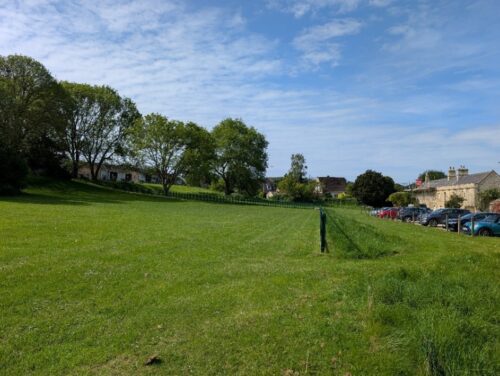
Despite the Herald’s use of ‘rear’ I believe that the games were played to what is today the front of the House, the Manor Drive side. The rear is simply too small and would have struggled to encompass a sensibly sized pitch quite let alone accommodating spectators and a marquee. The History of the Lansdown Club[2] tells of the pitch being on a narrow shelf on the hill (Bathford Hill) side – and recounts the entertainment that was had from the ball rolling down the slope or being thrown in from below and rolling down the other side. The book’s recall of farm labourers on a distant hill must, I think, have been Little Solsbury Hill to the north-west.
[1] The photograph includes Henry Grace standing far left, E.M. is in the middle of those sitting and the 14-year-old W.G. is standing fourth from the right. E.J. Morres and W.W. Taylor, also in this group, played that same year (1863) in the Bathford manor game both turning out for ‘Town’.
’
Bathford Manor house to the right with the ‘shelf’ to the left. (Author’s own image.)
The 1863 scorecard is very much of its time – a two innings match, relatively low scores, table-groaning quantities of food and so on. The Country team won after the match was decided on the basis of the first innings scores, time preventing the completion of the fixture. Murchison himself played for Lansdown as they were a man short.
There is in no doubt that these fixtures were wonderful days in the sun ‘for those with the means to enjoy them’[1]. As seems to have been common at the time the Church did have the means with three clergymen in the Country XI for this 1863 match. Crockford’s Clerical Directory of 1860 indicates that The Rev Earle (bowled Roberts for 15) is likely to have been John Earle from Swainswick Rectory; it lists a Philip Edward George at Combe Hay Rectory (although not the T P George listed in the scorecard). One wonders whether they were any more diligent in their duties than wicketkeeper Parson Yalden in Siegfried Sassoon’s ‘The Flower Shower match’ who ‘paid more attention to cricket and pheasant shooting than was fit and proper’.
The following August’s Herald (1864) records that Lansdown once more travelled to Bathford at the invitation of Murchison. The Manor House lawn was again selected for the match, its attributes as a scenic vantage point exceeding its usefulness as a cricket pitch in the Hearld’s view. ‘‘Nevertheless, a splendid match was played,’’ with the magnificent trees around the ground providing a source of shade. As in the previous year the first innings decided the game this time with the Town team running out winners.
[2] Horse and Cart to Helicopter, Lansdown Cricket Club 1825-2020
You must be logged in to post a comment.