

Cricket at Butleigh Court is a success story. The first overs were bowled in the mid-nineteenth century and today, 175 years on, there is still no sign of stumps being drawn
The Court itself was constructed in 1845–51 replacing an earlier building on the same site burnt down, it is thought, in the previous decade. (Fire was the scourge of many country houses.)
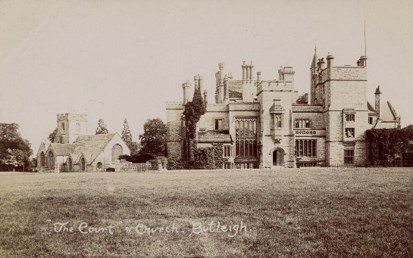
By the mid-1850s it was in the possession of Ralph Neville-Grenville MP and it was he who made the ground available for cricket. The house remained in the family subsequently but by the second world war it had become unoccupied with the roof being removed and interiors gutted. Restored in the 1970s it was divided into three dwellings.
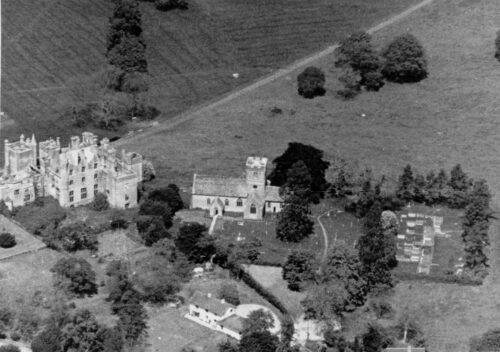
The cricket ground was originally thought to have been to the east of the house, so in the field to the far end of the small cemetery to the right in the photograph below. Anecdotally it remained the Butleigh ground until the 1960s when it moved to the north of the Manor building[1]. The current Butleigh Cricket Club confirms that its current incarnation dates to 1962 which would be consistent with this[2].
[1] To the area in the top left of the photograph.
[2] Communication from Butleigh CC 4 March 2026.
Ralph Neville-Grenville’s support for the game is reflected in newspaper reports beginning in the 1860s. A July 1865 Central Somerset Gazette account records a match between Baltonsborough and Butleigh at the Butleigh Ground. Noticeable immediately are the low scores, the visiting side totalling only 15 and 19 in their two completed innings, not unexpectedly losing to Butleigh, 86 all out in their only innings. ’Our worthy representative for East Somerset, R. N. Grenville esq’’ was present amongst the throng of ladies and gentlemen at the ground.
Two innings matches were in vogue in the late 1860s although not always completed. The Taunton Courier and Western Advertiser of 11 August 1869 reports a home game for Butleigh against Yeovil in which Butleigh ran out winners on the first innings, time not allowing the game to be played out.
In an age when newspapers would have been the only way to report matches, write-ups of village friendlies such as these were commonplace. So, too, were accounts of the social aspects of the clubs.
A case in point is the 1876 Butleigh Club Dinner for which The Central Western Gazette’s piece runs to several paragraphs. Mr F. Neville, Ralph’s son, represented his father in the latter’s capacity as President; much is made of the support of the honorary members in keeping the club going (‘cheers and musical honours’). Interestingly in the ‘thanks to the club officers’ section there is reference to some needle in one particular game suggesting that village friendlies then, as now, can sometimes have an edge to them. In the Gazette’s account ‘barristers’ in the field had claimed that a ball struck by one of the Butleigh batsmen, a Mr Laver, had been caught cleanly. Mr Pitt, the Butleigh Secretary, was treated in a ‘’shabby and ungrateful’ manner when he judged the ball to have clearly bounced first. Presumably Pitt was the non-striker or perhaps umpiring at the time.
Ralph died in 1886. But matches continued albeit with low team scores typical of the period, St Benignus (Glastonbury) dismissing Butleigh for only 34 in 1910. The club continued after the War as the ‘village club’ – there is a 1927 Butleigh team photograph held at the Somerset Record Office – and by 1928 appears to have been involved with the Mid-Somerset Village Cricket League; it beat a ‘Rest of the League’ team in a friendly at the end of that season. But the Butleigh Club must have folded sometime after that as the Western Daily Press reported attempts to ‘revive the village cricket club in November 1934’.
The attempt succeeded and the club continues today.
You must be logged in to post a comment.