

Somerset Country Houses come in many forms. Some remain with their original family. Some are owned by the National Trust. Some have been divided into flats. And some are no more. Ashwick Grove falls into the last category.
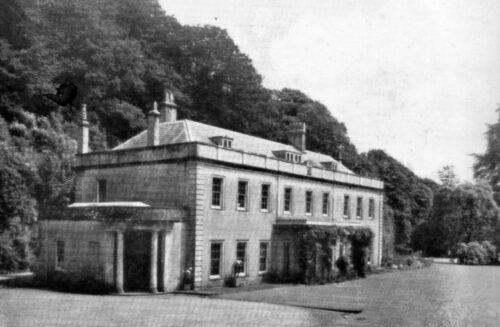
Ashwick Grove 1937 (Image courtesy of Oakhill and Ashwick Local History Group)
In its original grand state it had been home to major land-owners the Billingsley family. After the death of John Billingsey in 1811 it was sold to the Stracheys. These Stracheys were a minor branch of the Stracheys of Sutton Court in the Chew valley. They were Anglican, minor aristocracy, in politics, Justices of the Peace and owned a significant amount of farmland – in many ways admirably well-suited to running a Country House cricket team. And so they did. By the latter part of the nineteenth century the middle of three Richard Stracheys was at the helm; and it was he who had a passion for the game. It extended to his creating a cricket ground on the Ashwick Grove estate although like many of these long-gone grounds it is hard to be sure where it was. The land immediately surrounding Ashwick Grove is extremely hilly, the house itself having stood in a very narrow steep-sided valley.
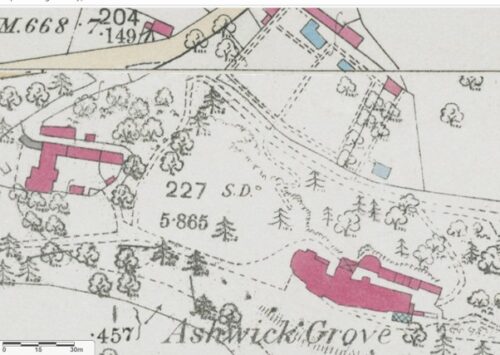
On this 1844-1888 map[1] the land to the south of the house, right hand corner, was in the Shepton Mallet parish and owned by a family called the Steeds. A more likely site is to the north, on the east side of the Bath Road (shown here as the pale-yellow band in the top left corner) perhaps in the field with the two lone trees in the right hand corner – or possibly on the west of the road although land owned by Strachey on that side was limited, most being owned by the Davis family. That said, both of these fields are relatively flat.
Games played at Ashwick Grove appear in local newspaper reports from the 1870s and 1880s. Local experts suspect that most of the Ashwick Grove players came from further afield – friends of the family, professional acquaintances; similar actually to accounts of games at a number several of the other Somerset Country House grounds at that time for example Burton Pynsent.
But an exception is Isaac Mitchell. He was the schoolmaster at the British School[2] and played in Strachey’s team. He was obviously a very good cricketer and a regular Strachey pick. In Mitchell’s entry in the school log for 19 Aug 1883 he says, ‘‘we had a holiday as R. Strachey Esq pressed me to go to Somerton to play at Cricket’’. Not much show of protest here on Mitchell’s part so good for him! He also mentions in the log that boys were taken out of school on several occasions, possibly by Strachey, to play cricket.
These late Victorian newspaper reports include Ashwick Grove fixtures against the likes of Lansdown and Shepton Mallet. There’s always a strong Strachey contingent in these Ashwick XIs although all of Richard’s fourteen or so children would have been too young to have turned out in the early- or mid-1870s so it is quite possible that Stracheys of this period may have been drafted in from the Sutton Court branch of the family.
Interestingly the Ashwick Grove ground also appears to have been used around this time by Oakhill CC. An earlier Shepton Mallet Journal piece from August 1859 tells us that, ‘’The young men of Oakhill … have established a cricket club.’’ So cricket would have been underway at Oakhill by the 1860s. Their pitch was on a field now called The Rec and was used by permission of the Spencers, co-owners of the Oakhill Brewery and builders of Mitchell’s (nonconformist) British School. So maybe Oakhill preferred Ashwick Grove when it was available; a footnote to a presentation in 1877 by the Oakhill club to Isaac Mitchell – who appears to have been a regular for both teams – states ‘’The Oakhill Club desires to tender their thanks to R. Strachey, Esq., for his kindness in allowing them to play their matches during the season on his beautiful ground’’.
And Strachey’s kindness was not limited to Oakhill. The Shepton Mallett Journal records a match at The Grove in August 1881 between Mr F. Spencer’s XI and The Rev. J. Hervey’s Tramps. This F. Spencer was Frederick, of British School and Rec fame above. ‘‘Owing to several disappointments’’ (in availabilities one assumes) Hervey’s XI were shot out for 27 chasing 175. Reassuringly there is a Strachey on each team and no doubt all involved enjoyed the lunch provided by the winning team’s captain.
Cricket reporting then disappears in the 1890s quite possibly because Strachey went to live in Belgium at that time. His son, the 3rd Richard Strachey, doesn’t seem to have been very interested in the game and the Strachey Estate itself was broken up and sold in 1937 following the death of this ‘Last Squire’.
In many ways the decline of Ashwick Grove from an eloquent reflection of English life to quiet ruin mirrors the story of its cricket.
[1] Image courtesy of Know Your Place.
[2] The ‘British Schoolroom’ was at Oakhill a village in the parish of Ashwick.
You must be logged in to post a comment.