

Victorian men did not formally “ban” the red cricket ball for women, but rather experimented with a blue ball in 1897 to prevent female players from allegedly fainting at the sight of the red colour, which was seen as too reminiscent of blood. The blue ball was largely unsuccessful as it was hard to see against the green grass and sky.
- The primary motivation, according to historical accounts, was a condescending belief, by Victorian men, that women would be frightened or faint upon seeing the traditional red ball.
- A blue ball was produced by Alfred Reader for Gamages Ltd. in 1897 specifically for women to use, which was considered a “curious experiment”. However the blue ball did not perform well in terms of visibility, making it difficult to use in actual games.
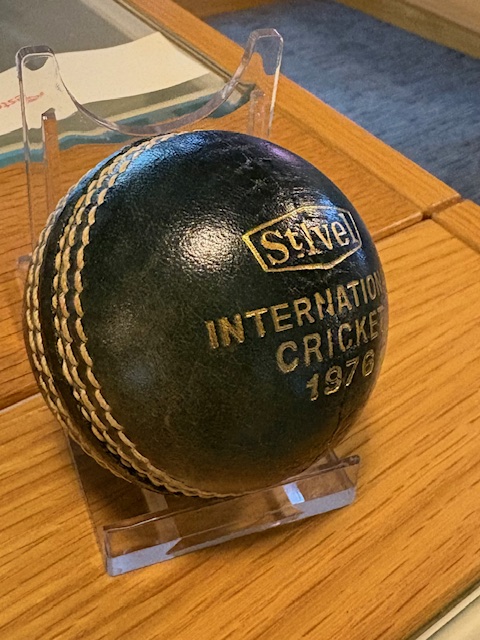
The history of the blue “St Ivel” cricket ball that is in the Women’s Cricket display, as described in Wisden 1977 is as follows:-
“Preparations for the fiftieth birthday of the Women’s Cricket Association were started over two years ago and were stepped up when it became known that the Australians had accepted the invitation to tour England for a Test series as part of the celebrations…
The most memorable event in a Golden Jubilee season packed with cricket, as well as social functions, was the falling, to women cricketers, of the last stronghold of cricket, Lord’s, and with the blessing of the MCC.
England played Australia on Wednesday, August 4 in a 60-over match and history was made. A centrally pitched wicket was provided and countless press, broadcasting and television personnel took an active interest
England celebrated the day fittingly with an eight wicket victory but forfeited the St. Ivel Jug, Australia having achieved the faster scoring rate in the combined Canterbury and Lord’s limited-over matches.
The scene in the Long Room afterwards was one to be remembered. Many spectators, most of them women, stood there to watch the President of the MCC, present the trophy to Australia and players of both teams received from the sponsors a specially manufactured blue cricket ball in commemoration of the historic occasion.”
’
You must be logged in to post a comment.