JOEL GARNER: 🟥I had great times at Somerset. The money was incidental: we had fun. I remember playing against Sylvester Clarke at Bath and he bowled two bouncers at me. I said, “Boy, you’re not going to get me out. This game’s going to finish and there’ll be other games when I’m bowling to you. Don’t you bowl these bouncers at me.” He came off and Roger Knight came on and I told him that if Sylvester Clarke couldn’t get me out then he wasn’t going to get me out either. I hit him for three sixes over long-on and we won the game. This was a one-day game in the middle of a four-day match – so we had two days left of the four-day match when this had finished. Sylvester was expecting and waiting for a bouncer. It never came. Later in the year, we had a return game at Surrey. I knew Sylvester had forgotten. I said to Sam Cook, the umpire, “watch this”, and I bowled a slower-ball bouncer and he gloved it behind. He stood and waited for the decision and Sam just said to him, “What are you waiting for?” That’s how we played.🟥
Note Big birds words… money was incidental.. Cricket was played with a passion..for the sport…
Contributed by and with acknowledgement to Mark Windsor
On Wednesday 10th April 2022, two Somerset players made remarkable centuries. One was scored for Somerset by Ben Green in the RLODC tie against Durham at Taunton, the other, the first ever in ‘The Hundred’, by Will Smeed for Birmingham Phoenix in a match against Southern Brave at Edgbaston.
Both performances were exceptional and both worthy of the outpouring of praise that has followed but, for me at least, it is the innings of Ben Green that will last longest in the memory. This is not simply because Green’s 157 was the higher score, nor was it because, after a relatively slow start, his last hundred runs were made considerably quicker than Smeed’s total score of 100 not out. And neither is it down to the fact that I am somehow biased against Smeed because his runs were scored in a tournament that has already undermined county cricket and threatens to be part of changes that will bring about its’ complete demise.
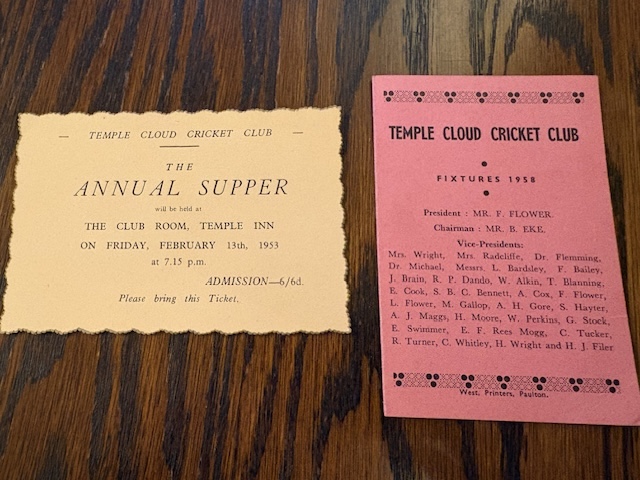
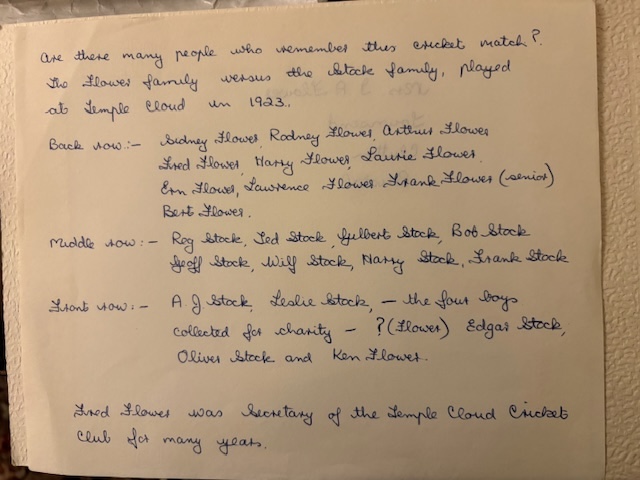
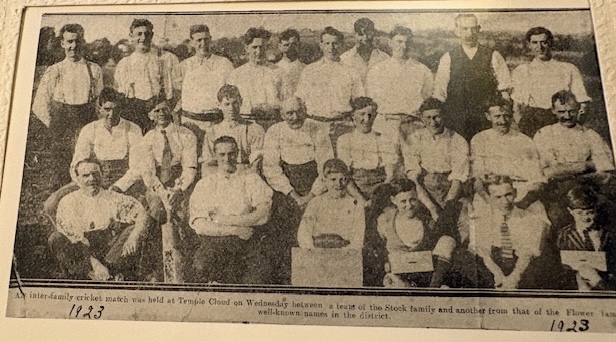
Temple Cloud Cricket Club was after the First World in 1919 by local residents of the parish of Cameley as they planned for the future and the return of sport.
On This Day 3rd August 1977 – 11,000 spectators crammed into the Ilkeston ground for this Gillette Cup quarter final between Derbyshire and @Somerset – 5 Test cricketers on either side – a game which Somerset won.
Ian Botham bowling v Derbyshire August 1977 -Picture courtesy of David Griffin
Four Test cricketers on either side. Somerset: Ian Botham, Viv Richards, Joel Garner, Brian Close; Derbyshire: Eddie Barlow, Mike Hendrick, Geoff Miller, Bob Taylor. Brian Rose (Dec 1977) & John Wright (Feb 1978) are yet to make their first Test appearance.
Borrington and Wright batting for Derbyshire and Ian Botham bowling, Viv Richards and Brian Close at slip with Joel Garner at long leg. Serious cricket!
And a comment from David Jenkins ”I was there, had the pleasure of driving the Chairman Len Creed to the match. What an innings from Rosie and a great win. Fred Swabroke a left arm dismissed Viv much to.the disappointment of the Somerset fans. Great days back then.”
and one from Mike Kerswell ”I remember it as the first time I saw Joel Garner playing for Somerset.”q
and this memory from a Derbyshire supporter ”I did my paper round first and was in the ground at 7am. Sat in front of the Somerset players in the pavilion which is where I got Viv’s autograph. Bought Closey’s benefit brochure and got Botham’s autograph at the close of play…15 years old, 45 years ago, and it feels like yesterday! ….Botham had just made his Test debut and his wife was pregnant. We queued for his autograph at the end and there must have been several hundred wanting his signature – Kathy marshalled the queue to make sure we only got one signature each!!
Kilve Cricket Club was founded sometime before 1860 when the first edition of the West Somerset Free Press, the local newspaper for this district of the County, recorded a reference to the Club.
With a proud tradition going back over 140 years Stogumber Cricket Club is one of the preeminent clubs in West Somerset with without doubt one of the best grounds in the area.
Article contributed to by Stogumber CC and Richard Walsh
With James Rew making his first team debut and Lewis Goldsworthy making his maiden first class century it was also pointed out in an article by Paul Edwards that the two young players set a fifth-wicket partnership record of 145 for Somerset against Lancashire, thereby overtaking that set by Sammy Woods and Henry Martyn at Taunton in 1905.
Photographs will be added to the Photo Gallery in due course
Picture courtesy Simon Best @SimonBest007
The Toss. Picture courtesy of David Griffin @DGriffinpix
Picture courtesy of Ralph Hesp @ralphindevon
Tom Abell in Action. Picture courtesy of Sir Michael Barber @MichaelBarber9
Peter Siddle in Action Picture courtesy of Sir Michael Barber @MichaelBarber9
Ben Green striking the historic runs. Picture courtesy of David Griffin @DGriffinpix
Picture courtesy of David Griffin @DGriffinpix
Picture courtesy of David Griffin @DGriffinpix
Somerset amassed the highest ever total in English domestic men’s T20 cricket of 265/5 beating their previous best of 250/3 v Gloucestershire in 2006 and exceeded the previous T20 record score in England, 261 for two by the Birmingham Bears against Nottinghamshire in June 2022, with Ben Green striking two sixes in the final over.
The winning margin of 191runs is also the highest in T20 cricket in this country.
Rilee Rossouw became Somerset’s most prolific scorer in a T20 season with 600 at an average of 50, with a strike rate of 197.36.
Derbyshire’s spin bowler McKiernan was hit for 82 in his four overs, again, the most expensive figures in men’s T20 cricket history, including 36 off one over (5x6s, 1×4 and 1 no ball (2)).
Also the Derbyshire innings (68 balls) was the third lowest ’all out’ innings in Blast history
63 balls / all out by Essex v Somerset at Chelmsford, 2011
67 balls / all out by Warwickshire v Gloucestershire at Edgbaston, 2020
68 balls / all out by Derbyshire v Somerset at Taunton, 2022
Somerset will play Hampshire at Finals Day for the 5th time in Somerset’s last 6 Finals Day appearances, which is by far the most common match-up on Finals Day – no other pair of counties have even met three times
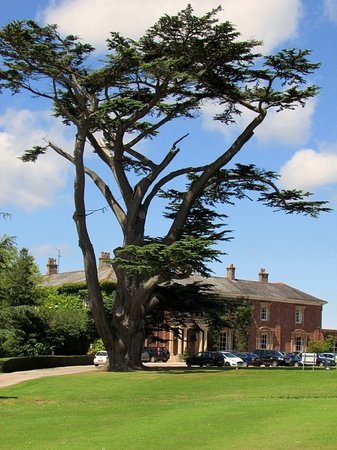
This beautiful ground lies behind Watts House, now known as Cedar Falls. Watts House was built by the Winters family and was completed in 1831.the family lived there until about 1890.
Wombat Cricket Club was established in 1984 by a small group of primary school teachers from the Taunton area who decided that they would like to play some social cricket. A meeting was arranged in the bar of the Colin Atkinson Pavilion (Somerset County Cricket Club) to discuss the type of club we wanted.
First reference to a Chard Cricket Club is found in the “Chard Union Gazette” of May 1841. A Club was formed during this month” for the practice of that truly English game…. Cricket”.
Taunton Cricket Club was founded in June 1829 when a group of men met at a pub in the town to discuss forming a club. Their first ground was at Orchard Portman Great Field, now the Taunton Racecourse.
The Castle Cary and Ansford Cricket Club was founded in 1837, but then had folded by 1840 when the Hadspen club was started. In 1859 the Castle Cary Cricket Club was formed although its headquarters were at Hadspen until 1870 when it acquired a field at South Cary where a pavilion was built in 1881.
The Somerset Women cricket team is the women’s cricket team for the county of Somerset. They play their home games at various grounds across Somerset, most often in Taunton, and are partnered with the regional team Western Storm.
First published in the Somerset County Gazette June 2022
LORD Archer of Weston-super-Mare has followed the fortunes of Somerset for over 75 years during which he has enjoyed the high spots and enduring the not such good times.
The Cricket Club was formed in 1920 when a number of employees who worked at ‘Clark Son & Morland Ltd’ (sheepskin tanners of Glastonbury) set up a side to represent the Company.
Formed in 1892 we believe, after 130 years of competitive cricket, Spaxton Cricket Club to be one of Somerset’s longest standing village cricket clubs. The Club is fully affiliated to the Somerset Cricket Foundation and play in the Monmouth Scientific League.
Founded in 1860, Ilminster Cricket Club has been a central part of the local community for over 150 years.With recent refurbishments to our beloved bar area (aptly nicknamed ‘the shed’) and recently renamed the Tony Rice Bar after one of the clubs longest and most devoted servants- Tony Rice- the club is continually looking towards the future.
Taunton School was founded in 1847 as Independent College, a boys-only school for dissenters – those who were not members of the Church of England. In the 1870s, the school’s governors purchased a site at the northern end of Taunton, on Staplegrove Road.
Clevedon Cricket Club was established in 1874 and is one of the leading clubs around the Bristol and Somerset area. The club is located at the top of one of the 7 hills in Clevedon and delivers beautiful picturesque views of the Mendips and Bristol Channel from its ground at Dial Hill.
The Club was founded on 4th October, 1929 at The Old School Room, East Horrington, Near Wells, Somerset. Situated on the edge of the Mendip Hills, Horrington is one of the smallest village clubs in Somerset. The Club first played in the 1930 season before being disbanded in 1950.
Following on from an earlier email contact related to the use of audio for the articles published on the museum website, for people with visual impairments, Discussions have taken place with a local Talking Newspapers Group, who will record the articles and make them available to both their own listeners and to ourselves. We will keep you posted regarding the progress we make.
Founded in 1920, Wemdon Cricket Club is based at The Green, in the heart of Wembdon village, 1 mile west of Bridgwater. The club boasts 5 Saturday XI’s, a Sunday XI, Ladies cricket section and a thriving junior section. There is a pathway in place for all ages through to Under 19’s and in to adult cricket.
The wonderfully named Vernon Tickell Hill was an amateur who played mainly for Somerset before WW1 – in 121 matches he scored 3842 runs at 19.21 with one hundred, believing almost every ball was there to hit. He also had one of the longest throws in the game
There are no accurate records as to the actual date St Andrews Cricket Club was formed, other than it was in the mid 1930s. In 1962, when I started playing, there were players who had played “pre war”.
Agricultural Showgrounds is the home venue of Frome Cricket Club who play in the Somerset Division of the West of England Premier League. The first recorded match on the ground was in 1882, when Frome played United Eleven
In 1859, a small group of members from the Bath YMCA decided that they wished to play the relatively new sport of cricket more seriously, and formed a new club, the Bath Association Cricket Club, playing for the next few years on top of Claverton Down, on the southern outskirts of the city
Cricket was relatively slow to come to Somerset, but by the early 19th century it was being played in a haphazard fashion, mainly on gentlemen’s country-house grounds. (See also the history of Watts House). Founded in 1825 Lansdown Cricket Club is one of the oldest in England.
Weston-super-Mare Cricket Club is an amateur cricket club based in Weston-super-Mare. Since the club’s formation in 1845, they have nurtured a number of players who have gone on to play for Somerset County Cricket Club and a select few who have gone on to play for the England Cricket Team.
Article to be added. The complete history of Weston-super-Mare Cricket Club can be found here.
Beckington is amongst the oldest surviving cricket clubs in the county with records dating back as far as 1884, and held in the possession of the club is an actual scorebook from that year.
Watts House (Cedar Falls near Bishops Lydeard) features greatly in the history of cricket with the County of Somerset and staged much ‘country house’ cricket rather than club or ‘Gents Players matches. There was never this distinction in country house matches (see Barry Phillips’s book on HT Stanley & Quantock lodge cricket).
To the lady (PH) who kindly emailed us regarding the use of Audio. We are looking at this and hope to be able to provide this facility in the near future. Unfortunately you email box is full so i cannot reply formally.
Records show a cricket match played at Knowle between “12 of Knowle against 12 of Norton “in 1859. According to Arthur Waugh’s book – One Mans Road – “in 1878 some sportsmen conceived the idea of a Cricket Club in a field across the meadow on the skirts of Withies Lane”.
Hampset was founded by two old boys of City of Bath Boys’ School – Brian Martin, who supported HAMPshire, and Ken Saunders, who was supported SomerSET. Their aim was to provide club cricket at an affordable price for school leavers wanting to continue playing. The first match was on 27 July 1940 against Odd Down at Odd Down Playing Fields.
The Tetton Park estate, Kingston St Mary is the former home of career diplomat and Somerset batsman Mervyn Herbert.
Herbert scored 854 runs in 42 matches, top scoring with a score of 78 at a batting average of 12.02 in the late 19th century and early 20th century. Marvin Herbert was born in 1882 at Highclere Castle, which was used as the set of Downton Abbey.
If you know of any place in Somerset connected to the history of Somerset cricket, you are more than welcome to let us know
Somerset Stragglers Cricket Club are a long established Nomadic cricket club playing on perfect Somerset & Devon pitches. This year (2022) will see us playing 15 midweek friendly fixtures, including a short tour to North Devon/Cornwall!
An audio version of the article can be listened to below.
Western Storm were formed in 2016 to compete in the new Women’s Cricket Super League, representing the South West.
In their inaugural season, they came second in the group stage, meaning they progressed to the semi-final, which they won against Loughborough Lightning. They play their home matches at the County Ground, Taunton, the County Ground, Bristol and Sophia Gardens.
Somerset was initially regarded as a minor county until official first-class status was first achieved in 1881 and held until the end of the 1885 season. First class status was then regained in 1891 and held ever since.
The Club has competed in the County Championship since 1891 and has subsequently played in every top-level domestic cricket competition in England.
On the 18th of September 1875, Somerset County Cricket Club was officially founded. We all know the story about how our Club came into being following the two-day match between the Gentlemen of Somerset and the Gentlemen of Devon at Sidmouth all those years ago, but to mark the anniversary of the club’s conception, we thought we would take a more detailed look at the history of the of its origins and the main protagonists involved.
Although August 18th, 1875 was the day that our Club was officially founded, the history of Somerset cricket goes back even further than that.
We can go as far back as 1798 to find a first recorded county match by a team bearing the name of Somerset. Eleven Gentlemen of Bath & the County of Somerset faced Eleven Gentlemen of Wiltshire at Devizes in a match that saw Wiltshire’s Gentlemen triumph. Following the match, a return fixture was organised between the two sides, and it was a game that caused something of a rumpus. Following a resounding victory for the Bath & Somerset team, it was alleged that several of their players were in fact drafted in from other counties.
Whilst interest in the game at the County level waned, several club sides sprung up throughout Somerset at places such as Somerton, Langport, Milverton, Taunton, Wiveliscombe and the Lansdown Club in Bath (see the individual Club histories)
A team bearing the name Somerset re-emerged in 1845 for two matches against Dorset. The first at Lansdown CC resulted in a two-wicket win for Somerset, with the second fixture at Dorchester seeing an even more resounding win, by an innings and 29 runs.
Dorset gained a modicum of revenge when the two sides met again at Kingston Park the following year, but Somerset cricket inexplicably disappeared once more.
The Gentleman of Somerset emerged to fill the void in 1860 to take on the Gentlemen of Devon at Culm Vale. The two sides clashed a further nine times up to 1871.
A prospective move to eliminate the malaise surrounding the game at a county level emerged in Yeovil in 1865 when a committee was formed in order to attempt to create a Yeovil & County Cricket Club. Sadly, for those involved, this project would not bear fruit.
This brings us back to that celebrated day at Sidmouth in 1875 and the important events that followed the fixture between the Gentlemen of Somerset and the Gentlemen of Devon.
The Somerset Gentlemen won the match by eight wickets, and after the conclusion of the fixture the team called a meeting. The discussions were chaired by Reverend Alexander Colvin Ainslie (pictured below) and the proposal was a simple one; that Somerset should have its own County Cricket Club in order to compete with the established Counties.
The resolution was passed and those present decided upon three key elements which should be progressed:
That it is desirable to organise annual matches against the neighbouring counties and against First Class clubs, such as the Incogniti, etc.
That the secretaries of leading cricket clubs in Somerset be communicated with upon the subject, and their co-operation invited.
That the clubs which possess first rate grounds, in convenient situations, be requested to allow the use of their grounds for county matches.
Edward Western, a teacher at Fullands School in Taunton, who had top scored for the Gentlemen of Somerset in the match, was requested to act as County Secretary and he set about writing the following letter and sending it to potential benefactors amongst the Taunton elite:
Sir,
I beg to enclose a copy of the resolutions passed at Sidmouth in August 1875, relative to the establishment of a county cricket club in Somerset. The following is the scheme:
That there shall be no county ground.
That the club shall depend upon its support by voluntary subscriptions.
That county matches shall be played on any ground in the county that may be selected by the Committee.
That a president, vice-president, treasurer, and secretary be nominated, and a committee consisting of nine gentlemen, three from each division of the county, shall be appointed.
Matches have been arranged against Dorset, Devon, South Wales, the Incogniti, and the Civil Service.
I am requested to solicit you to become a subscriber of 10s.6d. to the Somerset County Club.
This appeal is being made throughout the county, and it is hoped that the result will be as such to prevent the great expense of county matches falling too heavily on the individual players; otherwise, many good men are excluded, and the county cannot do itself justice.
I am, Sir,
Yours faithfully,
Edward Western, Hon. Sec.
Initially, this plea was not as successful as expected.
A meagre 112 subscribers were forthcoming and only £70 17s. was deposited into Somerset County Cricket Club’s initial bank account.
What of the players who featured that day?
Let’s find out a little more about those eleven players and what became of them.
Stirling Voules was appointed as Somerset’s first Captain. He was born in 1843 in Middle Chinnock and was a right-handed batsman and right-arm fast bowler. He attended Marlborough College before winning a place at Lincoln College, Oxford where he played for the Varsity team. After his graduation he began a teaching career. In 1878, he became the rector of Ashley, near Market Drayton.
Edward Wright was an all rounder who was born in Devon in 1858. Educated at Sydney College, Bath, he was one of only four of the players who featured for the Somerset Gentlemen that day who did not go on to play for the newly created Somerset team. He became a police officer in the West Indies but died as a result of injuries sustained following an outbreak of rioting in Montego Bay at the age of 46.
The origins of Edward Western, who became Somerset’s first Secretary at that inaugural meeting, are somewhat mysterious. What we do know is that he was born in May 1845, but the location of his birth is uncertain. What we do know is that he was placed into the care of the Edols sisters in Brislington at a young age. The sisters took in abandoned and orphaned children, giving them a home and an education. He eventually attended Fullands School and would stay on to teach maths. As mentioned previously, he top scored for the Gentleman of Somerset during that match at Sidmouth and as Secretary he was tasked with organising the fixtures for the newly created County Club. After resigning as Secretary, he returned to education and eventually set up a private school in Alcombe, Minehead. He remained in the town with his wife until his death at the age of 74 in 1919.
William Gresswell was another of those who did not eventually play for Somerset. The son of the rector of Kilve, he was born in 1848. He was educated at Somersetshire College in Bath before attending Brasenose College, Oxford. Following his graduation, he lectured in Classics and English Literature in Cape Town. He also wrote books on colonial history and geography whilst overseas. Upon his return to Somerset he was appointed rector of Dodington, Nether Stowey. A member of the Somerset Archaeological Society, he helped to secure funds which were used to acquire Coleridge’s cottage in Nether Stowey for the people. He remained in West Somerset for the remainder of his life. His son, named Bill, went on to play over 100 First Class matches for the County that his father had helped to found. Bill would also later go on to become President of SCCC.
William Pulman (pictured below) was born in Wellington in 1852. He was educated at Uffculme Grammar School in Devon before attending Marlborough College. He went on to gain a First in Classics at St John’s College, Oxford where he was also awarded blues at cricket and rowing. He played six matches for Somerset before playing for Worcestershire in 1879. He was ordained in 1876, and in 1889 he became rector of Wellington and West Buckland, a position previously held by his father. He remained in the post for 43 years. He passed away in the town in 1936, a year after celebrating his golden wedding anniversary.
Francis Reed was born in Ottery St Mary in 1850. He went to Exeter College, Oxford where he played cricket but failed to make the University XI. After graduation, he became a chaplain and a teacher at Fullands School in Taunton. He played regularly for Somerset until 1884 as a right-arm medium pace bowler. He also played rugby for Somerset. He eventually became headmaster at Donnington Grammar School in Lincolnshire, beating over 100 other applicants for the post. He transferred to a school in Yorkshire in 1887, but two years later he was living in Middlesbrough and offering his services as a tutor. It is reported that he spent a number of years lodging in doss houses, and from 1901 he was regularly admitted to the Stepney Workhouse in London’s East End and the Whitechapel Infirmary where he passed away in 1912.
Henry Dodington was born in 1843 at Horsington House, near Templecombe and was educated at Eton before making his way to Trinity College, Cambridge. Although he never made any impact on the cricket field, he was selected for the 1863 Boat Race. Sadly, a last-minute injury prevented his appearance. In 1865, he attended Wells Theological College, where he trained for the priesthood. He made his debut for the Gentlemen of Somerset as a 20-year-old in 1863 and appeared for the newly formed Somerset in 1876. He pursued a career in the church and travelled widely before become President of Somerset CCC in 1885. He was a keen archer and in later life he had a farm in Sherbourne. He died in the town’s hospital in 1916 at the age of 72.
Tristram Welman (below) was a highly regarded wicket keeper. He was born at Norton Manor, near Taunton in 1849 and was eventually sent to St Mary’s Roman Catholic College in Birmingham. He came from a wealthy family and was a well-known socialite. He made two pilgrimages to Rome, one in 1869 and one in 1877, and was rewarded with the Bene Mereti medal by Pope Pius IX. He played for Somerset until 1901, by which point, according to the Taunton Courier, ‘age had robbed him of his former brilliance’. During his career, he also played for Middlesex and the MCC.
Sealy Poole was one of the four players who never went on to play for Somerset. Born in Huntspill, near Bridgwater in 1850, he attended Exeter College, Oxford and was in the same year as Francis Reed (see above). He often played for Corfe CC and also featured for Fullands in Taunton. The likelihood is that he would have played for Somerset beyond 1875, but he took up the position of deacon at Hereford Cathedral meaning that he left the region. Via Worcestershire and Norton Fitzwarren, he became the rector of Chickerell, in Dorset. It was a position that he held for 42 years. In 1934 he retired to Weymouth, where he died the following year surrounded by his family.
Gordon Voules was the fourth man not to go on to make his bow for Somerset. Born in 1839, he was the brother of Somerset’s first captain, Stirling Voules. He worked as an auditor for the Admiralty and eventually received a knighthood for his outstanding service. He was married in Tiverton in 1866 and moved to London for a time. He died aged 84 in 1924.
Ernest Cassan was born in Bruton in 1835. After attending King’s School in Bruton, he was awarded a place at Magdalen Hall, Oxford. However, it allegedly took him seven years to complete his degree. He played cricket at university and took nine Cambridge wickets in his only Varsity match. He played for Somerset until 1878, at which point he joined Dorset. He became a mainstay at Lansdown CC in Bath, and a photograph from 1863 suggests that his cricketing prowess was even more remarkable given that he appears to have a physical disability with his left arm. Indeed, the Bath Chronicle describes his technique as ‘slow to medium left round-arm’ whilst noting that ‘his left hand was paralysed, and he placed the ball in it with his right.’ He eventually hung up his bat at the age of 63 in 1899. Sadly, he took his own life on Christmas Eve 1904. The official verdict of his death is ‘suicide by shooting himself during a fit of temporary insanity.’
This band of brothers paved the way for the heroes of today, and the rest, as they say, is history!
Many thanks have to go the researchers in Somerset Cricket Museum for assisting in the creation of this article. This piece would also not have been possible without the following excellent publications:
Somerset Cricketers 1876 – 1890 by Stephen Hill & Barry Phillips
Somerset Cricketers 1882 – 1914 by Stephen Hill
From Jimmy to Sammy by Peter Roebuck
This article has been republished with the kind permission of Somerset County Cricket Club
On this day May 4th 1957 Bill Alley made his debut for Somerset v Lancashire. His best season was his testimonial season in 1961 when, at the age of forty-two, he scored over 3,000 runs for Somerset.
A distinctly underwhelmed Ian Botham wad presented with a cake on his 22nd birthday by England tour manager Ken Barrington. Botham was at the airport ready to leave for that winter’s tour of Pakistan and New Zealand
Ten Test cricketers played in this match watched by 11,000 spectators in searing heat. Somerset won by 59 runs, Brian Rose 128, Joel Garner 5/30
I
That year Somerset played Middlesex at Lords in the final and it rained 3 days and they played a 15 over game late on the Friday lost toss batted first and lost game . Brian Close again feeling everything was against Somerset in his last year as captain.
I just saw your memory of Bill Andrews, who was my Great Uncle, by Mr. Mike Tarr, and thought I would drop you a line.
I have heard many stories about him and read his book about being a Professional Cricketer.
He played Cricket with me in about 1958 in Highbridge, I think. It was in his back garden and I was a 5 year old. He told me that if I wanted to play cricket I would have to face his type of bowling. He gave me his bat that was over the Fire Place and practiced with me. I was scared stiff and it felt real when he bowled. Then he put the bat away and got some bottles in his wall and started shooting at them with a pellet gun.
I did not realise that he was showing me an important lesson in life and even at 5 years of age I remember thinking what a great bloke. My Dad never did anything like that with me?
I never saw him play but, my Dad told me about him and I read his book. I heard in latter life that he was influential in Ian Botham’s development at Millfield School
As a Cricketer, not as a Scholar, Ahhhhhh
Is that true, or just wishful thinking. I remember he had huge hands and was a big guy.
We lived in Wiltshire so I did not see him too often. His brother was my Grandad who moved to Wiltshire to work in the Railways.
Gary later added: His book was interesting because, I think, Cricket was a bit of a Gentleman’s game and he was a rough diamond.
He had to fight to become a Professional Cricketer and then the Second World War probably stopped him from playing for England. There was another cricketer at Somerset who was very good but my Uncle Bill clashed with due to his background. This may be sour grapes, but my dad told me he was a tough cookie and could be argumentative and confrontational.
Ian Botham had a strong character, maybe Uncle Bill instilled that into him Ahhh.
We are very grateful to Brigid Riddell for two donations from her fathers cricket collection. An autographed salver commemorating the SCCC wins in the Gillette Cup and John Player League in 1979 and tankard presented to her father for his role as President of the Somerset Wyverns between 1984 and 1986.
Scorecard detailing Derbyshire’s then record score of 707-7 at Taunton in 2005 – the record was broken two years later when they made 801-8 on the same ground…Even James Hildreth had 4 overs.










You must be logged in to post a comment.